Drishyam - Was it Murder or Private Defence? Private Defence Explained..
Decoding Drishyam The Initial Act That Caused Death of Varun Through Indian Criminal Law. Was it really murder or private defence? Sections 96–106 IPC explained with key case laws.
Author, THelawcritiQue
11/11/20258 min read
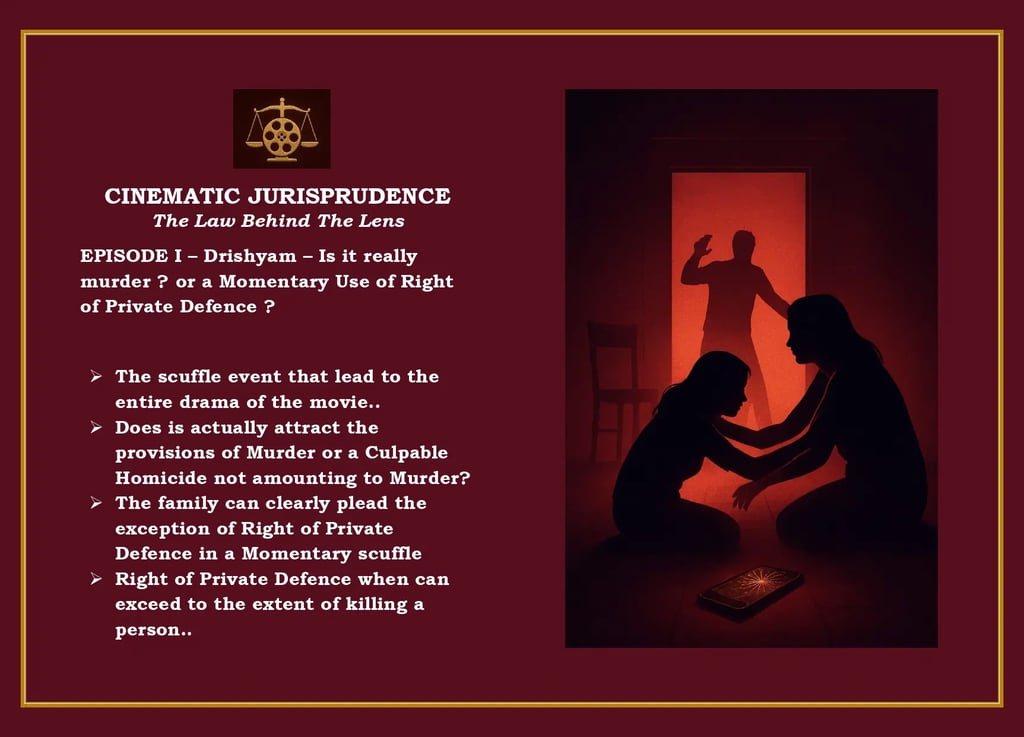
The incident of the movie may be briefed as follows -
the teenage son of a high-ranking police officer secretly records the protagonist Georgekutty’s daughter in a compromising situation
Georgekutty, a simple cable television operator living in a quiet village in Kerala, leads a peaceful life with his wife Rani and two daughters. In Drishyam, the central conflict arises when his family’s world turns upside down when Varun, the son of the Inspector General of Police, secretly records an intimate video of Georgekutty’s elder daughter, Anju in a compromising situation while she was at a nature camp. Days later, Varun arrives at their home and uses the video to blackmail Anju and her mother, threatening to expose them unless his demands are met. In a desperate attempt to retrieve the phone, Rani and Anju confront Varun inside their house. The confrontation quickly escalates into a violent scuffle — Varun becomes aggressive, physically attacks them, and in the chaos that follows, Anju strikes him with a blunt object, causing his accidental death.
But legally speaking, was it murder at all?
This episode of Cinematic Jurisprudence: The Law Behind the Lens explores one of the most fascinating legal questions inspired by Indian cinema — whether the act that triggered Drishyam constitutes murder under Section 300 IPC, or falls within the protective sphere of the Right of Private Defence under Sections 96–106 of the Indian Penal Code.
Understanding the Incident – What Actually Happened
When confrontation happens, Anju sees that Varun simply overpowers them. Varun not only assaults them, then he demands to Anju's mother to consent an intercourse with him in place of Anju which devastates her mental state. Showing the video, Varun himself forces onto the Anju's mother Rani where she keeps stepping back in a helpless situation. Seeing all this happening in front of her eyes, Anju in a desperate attempt to save her mother takes a blunt object and hits him on his head. This sudden blow leads to the death of Varun.
Now let us discuss this in a legal point of view. The family’s act that led to Varun’s death wasn’t premeditated.
There was no planning, no motive for gain, and certainly no criminal intent (mens rea). What existed was imminent danger and an instinctive act of protection. From a legal lens, the question becomes: was this an unlawful killing, or a lawful act in private defence?
The Legal Framework – Right of Private Defence under the IPC
Right of Private Defence forms one of the most important exceptions of an offence as provided under Indian Penal Code, 1860. Anything falls under exceptions shall not be considered an offence. The Indian Penal Code, through Sections 96 to 106, recognises that it is impossible for the State to protect every individual or its subjects at every moment. When encountered with an imminent situation of danger to one's life or person or property, an individual has the right to defend his life, property, and modesty even to the extent of causing the aggressor’s death. The provisions of some important sections of the chapter may be seen hereunder for quick reference.
Section 96 IPC
“Nothing is an offence which is done in the exercise of the right of private defence.”
Section 97 IPC
This right extends to:
Defence of one’s own body and the body of another.
Defence of property — movable or immovable.
Section 100 IPC
It permits causing death if the assault:
Causes reasonable apprehension of death,
Causes apprehension of grievous hurt, or
Is intended to commit rape or unnatural lust.
Section 99 IPC – The Limitation
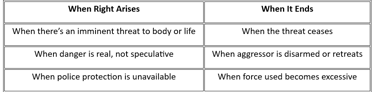
The right of private defence is not absolute.
It cannot be exercised when:
There is time to seek public authorities, or
The harm caused is more than necessary for protection.
Applying Law to Drishyam
Now let us carefully apply the existing law to the Drishyam scenario..
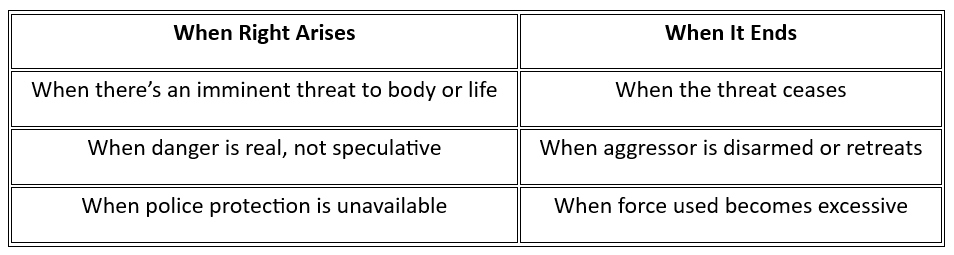
The assault was imminent (Varun was actively threatening and attacking Anju and Rani).
No time to seek police support or public authorities.
The threat was grave to the modesty and person of Rani.
The response was instantaneous- There was no time for per planned action. The attack was the survival instinct and defensive.
Right of Private Defence is justifiable even in the instance of killing the assaulter in the cases were the persons causes reasonable apprehension of or of attempt the commission of any offence as provided in Section 100 IPC. A person is justified in causing the aggressor’s death if the assault reasonably causes an apprehension of death or sexual assault. Thus, the act by Georgekutty’s daughter Anju arguably falls within the ambit of private defence, and not under Section 302 (murder).
Had the matter come before a real court about the liability for causing death of Varun the prime analysis might revolve around whether the force used by Varun was proportionate and necessary at that moment, for Anju to react so probable that it is her only survival instinct. Given the situation in the movie that escalated instantaneously, it appears to meet the standard of reasonable and immediate defence.
Case Law References
Gottipulla v. State of A.P., (1970) I SCC 235, The object of Right of Private Defence is clarified by the Supreme Court in the above case where it held that - every citizen, however law abiding he may be, should not behave like a coward when confronted with imminent danger or unlawful aggression. A person who is attacked has the right to defend himself even to the extent of causing death if there is reasonable apprehension of danger to life or grievous hurt.
Yogendra Morarji v. State of Gujarat (1980) 2 SCC 218 The Court emphasized: the fine line between legitimate self-defense and excessive defence leading to culpable homicide. While recognizing the inherent right to self defend one's self, the court equally underscores the necessity for this right to be exercised within defined legal boundaries. The case serves as a critical reminder that self-defense claims must be substantiated with credible evidence demonstrating an imminent and proportionate threat. In Drishyam, Anju's reaction was not measured or calculated at the same time it is also not exceeding Right of self-defence. It was an instant reaction without any pre mediated intention to cause harm or injury to the victim.
Our CritiQue — Law, Morality & Cinema
Initially the incident in the movie Drishyam feels like it was an accidental killing by a mother and daughter concealed out of fear. But on careful observation of happening of events, one can clearly see that it is an instinctive reaction to save her mother from her modesty being exploited by a force they cannot control or overpower.
Sections 96 to 106 IPC allows any person to cause protective violence to save himself/herself or anyone else against any offence causing injury to their body or to property. Section IPC, in particular allows that such protective force can even extend to causing of death in the cases of enumerated in the section where the assault reasonably causes an apprehension of death, grievous hurt, or rape.
In the instant scene Anju does exactly what she has to in order to save herself and her mother. She reacts to an imminent danger seeing her mother and herself threatened with sexual exploitation. There is no chance of mistaking the intention of aggressor as he expressly used a sexually explicit video to blackmail, isolate, and terrorize his victim. The idea of the aggressor is simply to compel and sexually exploit Anju's mother. The sudden danger is also evident as he proceeds to physically attacks her mother and corners them in their house. Under these apprehensions her attempt becomes a desperate shield, not a sword.
Yet the scene is legally complex because in the same set of facts, it can be argued that the danger is not enough to create apprehension upon Anju's mind that it is the only way of their escape, that threat was unarmed and the sudden blow was so fatal that it exceeded the minimal necessity. It is also not an out of place to mention that she could've used other options instead of using lethal force. Or even if she chose to use violence, it may be argued that the situation can be controlled even without causing death?
However, it is not lawful to put the person in a fear or apprehension to calculate the outcome of his activities. Law cannot be blind to human emotion and situational reaction. Circumstances of imminent danger and fear often eclipses judgment. The courts have repeatedly held that private defence is not to be measured with a “golden scale” in moments of fear.
Conclusion
By arguing pure legal point, the act that resulted in Varun’s death shall not amount to murder under Section 302 IPC, but it shall be considered as a case of self defence within its permissible boundaries of the Right of Private Defence an instinctive act to protect their life and dignity.
But the story doesn’t end there. The follow up to the scary incident is as brilliant as the movie itself. Georgekutty's later activities of concealment of the body and manipulation of truth attracts the criminal liability under Section 201 IPC - Causing Disappearance of Evidence. This brings us to another most interesting event that can be decoded with the help of criminal law. We will explain this in another episode -- Episode 2: “Drishyam — The Cover-Up: When Concealment Becomes Crime.”
FAQs – The Law of Private Defence
1. What is the Right of Private Defence under IPC?
It’s the legal right to protect oneself or another from imminent danger to body or property. It’s codified under Sections 96–106 of the IPC.
2. Can killing be justified as self-defence?
Yes, under Section 100 IPC, if there’s a reasonable apprehension of death, rape, or grievous hurt, even killing is legally justified.
3. Is the act in Drishyam legally considered murder?
No, based on the facts, it would likely fall under the protection of private defence or at most, culpable homicide not amounting to murder (Section 304 IPC).
4. Can self-defence apply even when there’s no weapon involved?
Absolutely. The law focuses on the danger, not the method of defence.
Disclaimer: This analysis is based on the Malayalam film “Drishyam” (2013), a work of fiction directed by Jeethu Joseph. The discussion is purely academic and for illustrative purposes under fair dealing provisions for criticism and review. All characters and incidents are fictional.
Drishyam — The Incident of Accidental Death — Is It Actually a Murder or The Right of Private Defence ? Right of Private Defence Explained
Episode 1 in our series "Cinematic Jurisprudence: The Law Behind the Lens — Understanding Crime Through Fiction"
Introduction – The Scene That Started It All
We are now referring to one of the most controversial and infamous incidents of a crime fiction movie Drishyam, where a simple, law-abiding man becomes the mastermind of a moral labyrinth.
Georgekutty, a humble cable TV operator, finds his peaceful life shattered when his daughter’s modesty is outraged by the son of a powerful police officer. What follows is a moment of chaos, a violent struggle, an unintended death, and the birth of a lie so perfect that it deceives the law itself.
This article is not intended to judge the positives or negatives of the movie, nor this is a critical or review of the writing or cinematographic excellence of the movie. We are motivated only to explain the law by applying it to the fictional incidents that lead to a confusing plot twists or unsettled disputes.
In this article let's discuss about the foundational incident in the movie Drishyam that lead to the sudden and unintentional death of Varun, the spoiled son of a powerful police officer. We thereby apply the same to the provisions of the real offences and their ingredients and consider if the accident really be considered a murder or just a case of self-defense.
Connect With Us Through
Connect with us
© 2025. All rights reserved.