
What is Transfer of Property? Section 5 Transfer of Property Explained with Supreme Court Judgments
What is Transfer of Property? Definition of Transfer or Property, What property can be Transferred? Section 5 of Transfer of Property Explained with Supreme Court Judgments
Author, THelawcritiQue
5/19/20257 min read
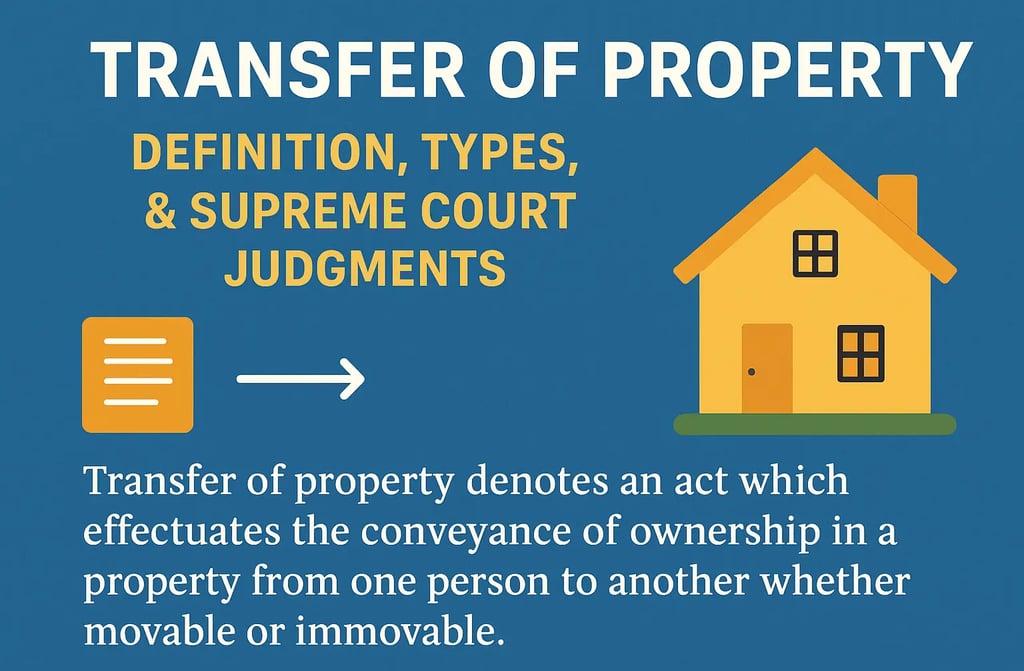

What is Transfer of Property? Definition of Transfer or Property, Explained with Supreme Court Judgments
Introduction:
In day to day regular financial transaction we may not hear the words Transfer of Property, Section 5 of Transfer of Property, Transfer of Property Act. But the regular transactions like sale, gift, mortgage, lease trace their origin from the terms What is Transfer of Property, Definition of Transfer or Property, Transfer of Property Act. The law relating to transfers, what is transfer of property are governed by the Transfer of Property Act, 1882.
Meaning of Transfer of Property:
Transfer of property in its literary meaning denotes an act which effectuates the conveyance of ownership in a property from one person to another whether movable or immovable. By transfer of property, rights in ownership will be completely shifted from one living person to another with a valid document binding on both parties to the effect of the terms and conditions enunciated in the draft of the document.
Definition of Transfer of Property
A transfer may either be conditional or unconditional; partial or permanent; in present or in future; and it may also be between two persons or between a group of persons.
The term ‘Transfer of Property’ is defined under section 5 of the Transfer of Property Act, 1882.
Section 5. Transfer of property” defined.—
In the following sections “transfer of property” means an act by which a living person conveys property, in present or in future, to one or more other living persons, or to himself, or to himself and one or more other living persons; and “to transfer property” is to perform such act.
The transfer of property simply means that activity through which one living person formally transfers his interest in property to another person. It can be seen that the section mandates a transfer should be between two living persons. A transfer between a living person and non-living person shall not be considered a transfer under the definition of Transfer of Property Act, 1882, section 5.
Therefore, a transfer made in favour of non living entities viz., idol, god or persons who are dead is not a valid transfer under the Transfer or Property Act. The position can be clearly identified from the following decision. The Hon'ble High Court of Andhra Pradesh, in its decision on
Tangella Narasimhaswami case, AIR 1927 MADRAS 636, elucidated that - it is unnecessary to pursue this point further as the document is not a gift to an idol but to Sri Kodanda Ramachandra Moorthy the Almighty, and by no stretch of imagination, legal or otherwise, can it be said that the Almighty is a living person within the meaning of the Transfer of Property Act.
Who Can Transfer and Receive Property?
The section further reads as follows - in this section “living person” includes a company or association or body of individuals, whether incorporated or not, … thus a juristic person viz., a corporation, a partnership firm, an association, a trust registered as per the rules and which are legal persons in the eyes of law also come under the purview of the living persons under section 5.
This means that a transfer can be made between a company to another company or a person or group of persons or even to private persons and companies jointly which is valid under section 5 of the Transfer of Property Act. The transfer of property Act provides for various kinds of valid transfers which are sale, gift, mortgage, lease, exchange etc.
Conditional and Unconditional Transfer.–
"..a transfer may either be conditional or unconditional.." - it is always not necessary that the transfer of property should completely transfer the interest in property unconditionally. Sometimes a transfer may be final and disposing the interests and rights finally without any conditions. Such transfer is an unconditional transfer.
Sometimes a deed of transfer may impose a specific condition that has to be fulfilled even after such transfer. A transfer maybe made on a fulfillment of a specified condition prior of after the transfer. In such case the transfer becomes valid only in the case when the specified condition is fulfilled by the other party. Such a transfer is known as conditional transfer. If the other party did not fulfill the condition as mentioned prior to the transfer, the transfer becomes void.
The Supreme Court also propounded in Renikuntla Rajamma v. K. Sarwanamma, AIR 2014 SC 2906 where a gift deed was executed transferring ownership of property to the donee (daughter-in-law), but with a condition that possession would be handed over only after the donor's death. The validity of the gift was challenged on the ground that the condition postponed possession, hence it was not a completed transfer.
The Supreme Court upheld the transfer ruling that the ownership was transferred immediately, and only possession was deferred, which is valid under the law. So a gift deed executed on fulfillment of a condition can be revoked if such condition is not met by the donee. Acceptance and Non-Acceptance of a Gift Deed.
Transfers in Present and Future
"..in present or in future. – a transfer may be made in present which instantly transfers the interest in property from transferor to the transferee. A transfer of property by way of sale, gift or any kind with an immediate effect of conveyance of interest in property from one person to another is a transfer in present.
Whereas the interest in property created to take effect in the future i.e., if the interest or possession is to begin in the future such transfer is also valid under the above section. Even though the transfer will be made in future, the deed or agreement to transfer must be executed in present.
For example if A transfers his property to B with effect from 1st January next year, the transfer is valid if it is executed now, and the interest takes effect in the future. But a promise to transfer property in the future without executing a proper deed in present is not a valid transfer under Section 5.
In Ram Kumar v. Jagdish Chandra, AIR 2004 All 344 a document stated that property would be transferred in the future, but no immediate conveyance was made. The court ruled that a mere agreement to transfer property in future is not a "transfer" under Section 5.
Transfer by Single and Joint Owners
Singly or jointly. – a transfer may be made by one person or a group of persons or even jointly by private persons and a corporation in favour of one person or a group of persons or even jointly to private persons and a corporation. The act does not specify any restrictions on transfers by and in favour of more than one person or corporation or legal person. The act only mandates two persons on each side and the maximum can be any number of persons without a limit.
Co-Ownership-
The concept of Co-Owners actually means that a property can be owned by more than one person at once as joint ownership. Thus a transfer can also be made by or in favour of more than one persons. When two or more persons jointly purchase a property, such transferees co-owners or joint owners.
The supreme court while disposing Kochkunju Nair vs. Koshy Alexander, (1999) 3 SCC 482, clearly established the principles of co-ownership as "The concept of ownership imports three essential rights, namely, right to possession, right to enjoy and right to dispose. All three essentials are satisfied in the case of co-ownership of land. All co-owners have equal rights and coordinate interest in the property, though their may be either fixed or intermediate."
Therefore, the extent of shares is also not material when the question is about the rights of a co-owner as the other other co-owners. The co-owners might not have equal shares but they actually have equal rights with the other co-owner with respect to his share of the property.
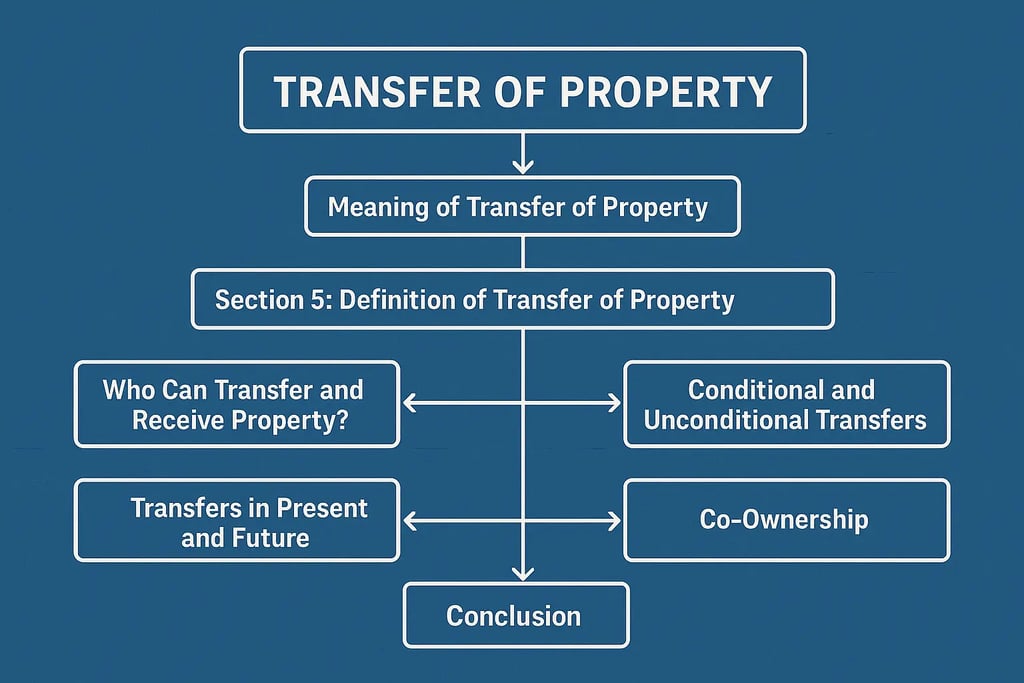
Conclusion. –
Thus ‘transfer of property’ is a formal way of conveyance of interests in a property from one person to another person whether movable or immovable in any ways mentioned in the Transfer of Property Act, 1882. The transfer of property act majorly provides for five kinds of transfers in its provisions viz., Sale, Gift, Mortgage, Lease, Exchange. Along with these the Transfer of Property act also provides for transfer of movable properties, actionable claims and easement rights.
Frequently Asked Questions - FAQs on What is Transfer of Property (Section 5, Transfer of Property Act, 1882)
1. What is the meaning of “transfer of property” under Section 5 of the TPA?
Section 5 defines transfer of property as an act by which a living person conveys property, in present or in future, to one or more other living persons. The term “living person” includes individuals, companies, associations, and bodies of individuals.
2. Can property be transferred to a deity, temple idol, or a person who is dead?
No. A transfer under Section 5 must be between living persons. Courts have held that a transfer to a deity or god does not qualify as a transfer under the Act, unless the deity is treated as a juristic person under specific religious endowment principles.
3. Is a conditional transfer valid under the Transfer of Property Act?
Yes. A transfer may be made subject to fulfillment of certain conditions. The transfer becomes fully effective only when the specified condition is met. For example, conditional gifts are permissible if the condition does not violate public policy or statutory restrictions.
4. Can a transfer be made to take effect in the future?
Yes. A transfer may be executed today and take effect on a future date. However, a mere promise to transfer property in the future without executing a present deed is not valid under Section 5.
5. Can multiple persons jointly transfer or receive property?
Yes. The Act does not restrict the number of transferors or transferees. Property may be transferred by one or more persons, and it may be transferred in favour of one or several persons jointly, including companies or associations.
6. Do co-owners have equal rights in a joint property?
Yes. Co-owners possess equal rights to possession, enjoyment, and disposal of the property, even if their shares are unequal. Each co-owner has an independent and coordinate interest in the entire property.
Note : This article is researched, created and published by the Author, THelawcritiQue. The content is prepared by referring to statutory provisions and judicial precedents for academic discussion and general legal awareness as applicable in India. While due care has been taken to ensure accuracy, the information provided does not constitute legal advice.
Connect With Us Through
Connect with us
© 2025. All rights reserved.