
Police Refused to Register FIR? How to File a Private Complaint under Cr.P.C.
Police Refused to Register your Crime? Know the Complete Legal Procedure involved in Filing a Private Complaint before a Judicial Magistrate : Sections 154, 156 (3), 190 & 200 Cr.P.C. Explained with Key Supreme Court Judgments
Author, THelawcritiQue
11/20/202511 min read
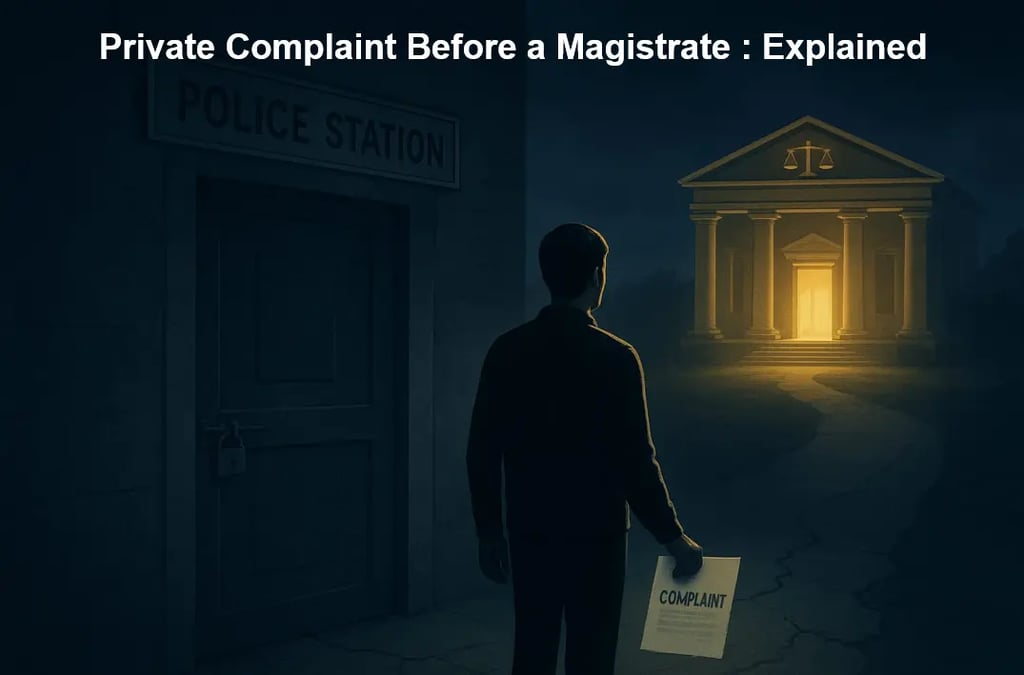
Police Refuse to Register Your Complaint.? How to File a Private Complaint Before a Magistrate
Introduction
Being a victim of a crime is so frustrating that the authorities are so busy even to hear about the occurrence of the crime. Imagine walking into a police station, carrying the emotional weight of being deceived, cheated, threatened, robbed or assaulted and the police authorities simply neglect your story. Also in several cases we often hear police say - “It’s a civil matter, we can’t register an FIR.”
Even if it is a criminal matter, we several times faced the situation that the SHO is assigned with another duty or the to come again another day as they were too busy doing other duties. It is a common scene in any police station across India. What should we do when we face such situations? Well Section 200 of Cr.P.C. answers this question permitting the victim to approach the court directly in case of delay or refusal to register a crime by the police.
When the police refuse to register your complaint or delay taking it on file, the Criminal Procedure Code (CrPC) prescribes a particular procedural right by filing a private complaint before the Magistrate, through which your issue will be heard directly by the judge. This remedy it is a statutory right provided by the legislature to every citizen. In such case, the Magistrate can either 1. order investigation or even 2. directly take cognizance of the offence.
In this article, we provide with you the step by step procedure what to do when police refuse to register your FIR, how to file a private complaint under Section 200 CrPC, and how Supreme Court precedents supervise procedures regarding private complaints.
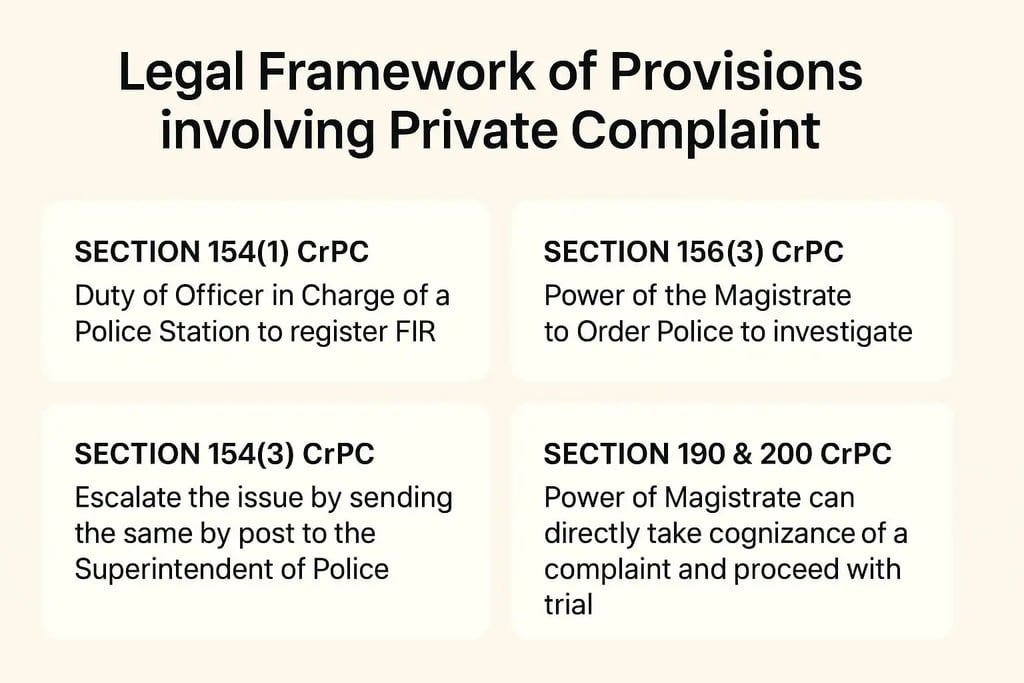
Legal Framework of Section 154, 190 and 200 Explained
Let us now study about the detailed framework of the provisions of the Criminal Procedure Code that deal about reporting of the crime, duty of the police to register crime, what to do when police refuse to register crime. The provisions providing for Private Complaint are as follows ..
Section 154(1) CrPC: Duty of Officer In Charge of a Police Station to register FIR.
Section 154(3) CrPC: Escalate the issue by sending the same by post to the Superintendent of Police.
Section 156(3) CrPC: Power of the Magistrate to Order Police to investigate.
Section 190 & 200 CrPC: Power of Magistrate can directly take cognizance of a complaint and proceed with trial.
Section 154 (1) - Duty of the Officer In Charge of a Police Station to Register a Crime
(1) Every information relating to the commission of a cognizable offence.., ... the substance thereof shall be entered in a book to be kept by such officer in such form as the State Government may prescribe in this behalf.
The intention of the section is very clear.. "the substance of the information shall be entered in a book kept for this purpose by the officer in charge of a police station". The procedure of entering the information in the book is nothing but taking the complaint on file. The prescribed form for entering the information by the State Government is called the "First Information Report - FIR".
The law does not allow any discretion upon the Officer-in-charge of a Police Station to decide on whether to register or not to register a case. The words "shall be entered" denote that when an information about the commission of a cognizable offence is given, the Officer-in-charge of a Police Station has to register the crime and then proceed to begin with the investigation. It is mandatory for the Officer-in-charge of a Police Station to take the information from the victim or informant.
But the reality of the situation is too different. People in such situations often face refusal from police or maybe inordinate and abnormal delay. Do we have to give up on this right there? No.. the Law provided the next Step to escalate the matter in case of failure or refusal by Officer-in-charge of a Police Station to register the information. The same is provided under Section 154 (3) as follows..
Section 154 (3) - Sending the Information by Post to Superintendent of Police
(3) Any person, aggrieved by a refusal on the part of an Officer in charge of a Police Station ... may send the substance of such information, in writing and by post, to the Superintendent of Police concerned who, if satisfied ..., shall either investigate the case himself or direct an investigation to be made by any police officer subordinate to him...
Sub-Section (3) of Section 154 Cr.P.C. provides the procedure to be followed if the Officer in charge of a Police Station refused to record the information, the aggrieved can send the same to the concerned Superintendent of Police, in writing through post. The Superintendent of Police, after receiving such information if he satisfies that a cognizable offence has been committed, may either investigate the same himself, or direct any any police officer subordinate to him to investigate into the matter.
When an Officer-in-charge of a Police Station is given with a definite territorial jurisdiction, the Superintendent of Police has to supervise more than one of such police stations., generally more than 5-6, which makes it impracticable for the Superintendent of Police to take notice of every such information or post. Which is why we get no attention from the Superintendent of Police also in most cases.
This is where the real power comes in. Section 156 (3) read with Section 190 of Criminal Procedure Code, 1973 gives the aggrieved person direct way to approach the Court i.e., Magistrate with his Complaint famously known as Private Complaint.
Section 156 (3) - Magistrate Empowered to Order Investigation
(3) Any Magistrate empowered under section 190 may order such an investigation as above-mentioned.
Even if the Superintendent of Police also refused or failed to take notice of the substance of information regarding the commission of a cognizable offence, The Magistrate empowered under Section 190 Cr.P.C. can direct the police to investigate the matter. But the power of the Magistrate is not limited to ordering police to investigate. Section 190 of Cr.P.C. empowers the Magistrate to even take cognizance of an offence.
Section 190 Cr.P.C. - Cognizance of Offences by Magistrate
... any Magistrate of the first class, Magistrate of the second class specially empowered in this behalf may take cognizance of any offence--
(a) upon receiving a complaint of facts which constitute such offence;
(b) ..;
Thus, Section 190 (1) of Cr.P.C. empowers any Magistrate of First Class, or any Magistrate of Second Class who was specifically in this behalf to take Cognizance of any offence upon "receiving a complaint of facts". This complaint of facts is nothing but a complaint filed by the complainant who is aggrieved from inaction by police.
Thus, if police say no to you, the court can say yes and direct the police to look into the issue if the issue can show the commission of a cognizable offence. Section 200 of Cr.P.C. provides further procedure for examination of complainant and witness in case of a private complaint.
Section 200 of Cr.P.C - Examination of Complainant and Witnesses
A Magistrate taking cognizance of an offence on complaint shall examine upon oath the complainant and the witnesses present, if any,...
Section 200 Cr.P.C. provides the procedure that the Magistrate should follow when he receives a complaint on his file. He shall record the statements of complainant and witnesses if any in writing and the same shall be signed by the person deposing such contents. After this step if the Magistrate is satisfied that an offence was committed, the Magistrate may either direct the police to investigate or issue process and begin trail.
Important Judicial Precedents
It is the duty of the Police to Register FIR without any preliminary inquiry when an information is received as to commission of a cognizable offence. The Supreme Court Held that preliminary inquiry is required in some special cases involving matrimonial disputes, commercial offences, or medical negligence. Otherwise when the information discloses a cognizable offence, the registration of FIR is mandatory - Lalita Kumari v. Government of Uttar Pradesh (2014) 2 SCC 1.
Priyanka Srivastava v. State of U.P. (2015) 6 SCC 287
The Court identified the increasing number of private complaints in case of police not registering FIRs. In order to prevent abuse of process of the court and ensure that the remedy is not used as a tool of harassment, The Court made it mandatory to file every 156(3) CrPC application along with a verified affidavit.Sakiri Vasu v. State of U.P. (2008) 2 SCC 409
In this case the Supreme Court established that if a person is aggrieved by the inaction or refusal by police to register an FIR or conduct a proper investigation, he can seek appropriate relief from the Magistrate under Section 156(3) of the Cr.P.C., not the High Court. The Magistrate has ample amount of powers to order the FIR to be registered, direct a proper investigation, and even change the investigating officer if they deem it necessary.Aleque Padamsee v. Union of India (2007) 6 SCC 171
The Supreme Court further reinforced that the aggrieved person due to police inaction must first approach Magistrate under Section 156(3) CrPC before resorting to constitutional remedies.
Read our other posts on Liability of a Bank Maintaining Locker in case of Unforeseen Thefts
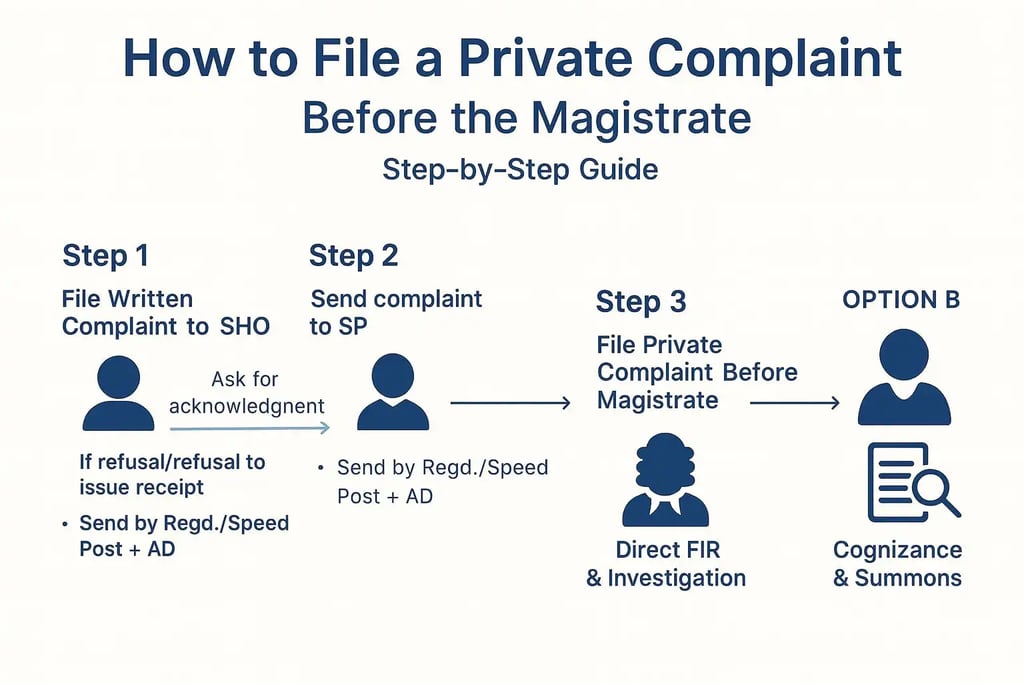
How to File a Private Complaint Before the Magistrate : Practical Step by Step Guide to Legally File a Private Complaint
Step 1: The Initiation - Written Complaint
Prepare the complaint i.e., the information in writing with factual narration of the occurrence of the crime and submit it to the Officer In Charge of a Police Station also called the Station House Officer (SHO). This is the beginning step of successfully and legally initiating a private complaint. After submitting the complaint to the SHO -
Keep two copies of the same complaint for future reference.
After receiving the complaint, the police must issue an acknowledgment with date and signature. So ask to provide with the receipt or acknowledgment.
If the SHO refuses to receive it, or refuses to issue a receipt or acknowledgment, send the same addressed to the SHO by Registered Post / Speed Post with acknowledgment due. This post acknowledgment will serve as the proof of submission of complaint to the SHO.
Step 2: The Escalation - Forward the Complaint to Superintendent of Police
Even after submitting the complaint to the SHO, wait for a few days typically a 5 days to a week . If no FIR is registered, then send the copy of the complaint addressed to the Superintendent of Police (SP) through Registered Post / Speed Post with Acknowledgment Due. This is an important step mandated by the Statute because courts often reject private complaints which do not comply Section 164 (3) CrPC.
Step 3: Filing a Private Complaint Before the Magistrate
When the Superintendent of Police also die not initiate investigation or direct his subordinate to register FIR, the next move is to file a private complaint. Approach the Judicial Magistrate First Class (JMFC) or Metropolitan Magistrate within the local limits where the offence was committed and file a private complaint. Here there are two possible practical remedies which will be decided by the Court based on the circumstances and evidences on record. They are -
(a) Seeking the Court to Direct Police to Register FIR, Investigate and Submit Report:
In cases where investigation is necessary i.e., to collect evidence, examine material witnesses, seize crime property etc., the step taken by the Magistrate is to direct police to register an FIR and investigate under section 156 (3) of Cr.P.C.
If such direction is made to the police by the Magistrate, the Police will immediately register the crime, initiate investigation and submit a final report / charge sheet under Section 173(2) Cr.P.C after the completion of the investigation. Though it is not always mandatory to only give direction to police. The Magistrate may directly take cognizance of the offence if -
(b) Take Cognizance of Offence and Issue Process
If the case on record discloses substantial evidence and witnesses, enough to satisfy the Magistrate that an offence has been committed, The Magistrate can take cognizance of the offence. In that case the Magistrate issue summons to the accused and proceed with trail of the case. initiate proceedings against the accused.
Common Mistakes To Avoid While Filing a Private Complaint
Not Sending the Complaint to Superintendent of Police - Forwarding of the complaint to the Superintendent is not a formality but it is a statutory requirement, non compliance of which incapacitates the Magistrate to intervene. In several cases, Private complaints get returned or dismissed due to non compliance of Section 154(3).
Stick to the Facts Instead of making Allegations - The Complaint must contain the factual narration in a chronological order. It should not contain emotional grounds and vague allegations.
The Private Complaint must be Supported by an Affidavit in Sworn - After the Priyanka Srivastava Case, the Court felt it necessary that the person making the complaint shall sworn the said facts in affidavit. If the Complaint is not support by an affidavit signals lack of reliability.
Filing itself Does Not Indicate Case Registration. - The power of the Magistrate under Section 190 Cr.P.C. is purely discretionary. You cannot claim to take the complaint on file as of right. The Magistrate must be satisfied as to the occurrence of the offence basing on the evidences and witnesses.
Procedure on Directing the Investigation: After an order for investigation is made, the police will investigate case, examine wtinesses under Section 161 Cr.P.C. and submit a final report / charge sheet under Section 173(2) Cr.P.C. The complainant has the right to seek copies of the report, and he can file a protest petition if not satisfied with the investigation or even pursue a revision before Sessions Court. We can cover these subsequent proceedings in a separate post.
Our CritiQue: Importance of the Remedy
In a country like India, where executive authorities are highly influenced by various external factors, the provision of private complaint ensures judicial oversight to force police to enforce citizen rights. It ensures constitutional protection over the citizen’s fundamental right to justice under Article 21 of the Constitution of India.
The law seems watertight on theory. But in practice, it’s often clogged by rigid procedures, bureaucracy and departmental backlash. Even after Lalita Kumari's Case, number of complaints are never Registered. Though there is a remedy, it requires patience, number of adjournments and preferably a legal counsel and also is expensive.
The Supreme Court has repeatedly reminded that no police officer has discretion to refuse registration of a cognizable offence. People need to know about the right to approach Judicial Magistrate in case of a negligence by police. So the next time when police refuse to take the complaint, remember the law through provisions of Private Complaint ensures no crime can go unheard.
Frequently Asked Questions (FAQs)
Is it Mandatory to Register FIR on a Complaint?
Yes. It is the Duty of the Police to Register when information as to the Commission of Cognizable Offence is received. The Supreme Court also held it mandatory to register FIR in Lalita Kumari's Case.
What should I do if the police did not register my Complaint?
First, send the substance of the complaint to the Superintendent of Police through Registered Post/Speed Post under Section 154(3) CrPC. If still no action, file a private complaint before the Magistrate under Section 156(3) CrPC.
When should I file a Private Complaint Under Section 156(3) CrPC?
An application under Section 156 (3) to order investigation is required when police investigation is necessary to obtian evidences and examine witnesses.
What is the difference between Section 156(3) and Section 200 CrPC?
Section 156(3): Empowers Magistrate to order FIR registration and police investigation.
Section 200: Empowers Magistrate to take cognizance immediately and proceed with trail.
Is it mandatory to file a Sworn Affidavit for a Private Complaint under 156(3) CrPC?
Yes. After Priyanka Srivastava v. State of U.P., a sworn affidavit is compulsory to prove the genuineness of the complaint is genuine and to confer accountability on the complainant not to file false complaints.
Note : Certain lines and parts of the sections from the Code or Criminal Procedure, 1973 or any act in force are been reproduced from the Bare Acts, for purposes of reference, academic, commentary and legal analysis only. We do not claim any copyright nor do we intend to use any copyrighted content. For Further clarification read official Bare Act..
For better understanding on Criminal Law - Read our Episode 1 - Drishyam Act One - Was it Murder or Right of Private Defence?
Connect With Us Through
Connect with us
© 2025. All rights reserved.